UNESA Promotes Indonesian Culture in Vietnam Through Batik Mask Workshops
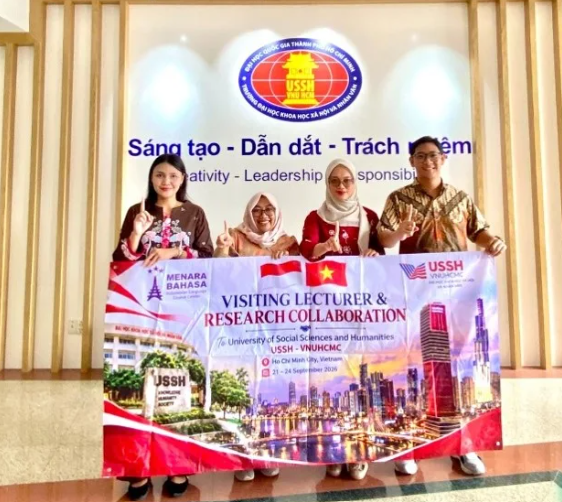
Ho Chi Minh City, JurnalPost.com — Batik masks have
become a key medium for Universitas Negeri Surabaya (UNESA) to introduce
Indonesian culture to students in Vietnam. Through an international community
service program, UNESA academics invited students to explore the richness of
Indonesian culture while fostering cross-cultural dialogue between the two
nations.
Baca Berita
The event took place at the University of Social Sciences
and Humanities, Viet Nam National University Ho Chi Minh City (USSH–VNUHCM),
Vietnam, from September 21–24, 2026. In addition to the batik mask workshop,
this academic visit included visiting lecturersessions, knowledge
exchange, and the exploration of research collaborations.
The UNESA team was led by Dr. Hespi Septiana, M.Pd., who
employed a cultural learning approach that combined traditional art
appreciation, creativity, and cross-cultural communication.
In the community service program titled "Batik Mask
Introduction Training as a Medium for Indonesia–Vietnam Cross-Cultural
Dialogue," students were encouraged to understand batik from a broader
perspective, rather than viewing it merely as an art piece or craft product.
Participants studied the visual elements of batik masks,
ranging from motifs and colors to shapes and the cultural values embedded
within them. These elements served as a basis for discussions to identify
similarities and differences in cultural expression between Indonesia and
Vietnam.
This approach provided students with the opportunity to
engage actively in the learning process. They did not just receive information
about Indonesian culture but were also encouraged to develop their
understanding through interaction and the exchange of perspectives.
The head of the UNESA community service team, Dr. Hespi
Septiana, M.Pd., explained that batik masks were chosen because they possess
compelling visual characteristics while embodying Indonesian cultural identity.
"Batik masks serve as a relatable medium for
students because they blend visual aspects, creativity, and cultural identity.
Through this activity, we aim to create a space for dialogue that allows
Vietnamese students to learn about Indonesia while discussing the cultural
similarities and differences between our two countries," said Hespi.
According to her, international community service programs
provide universities with the opportunity to extend the benefits of education
and knowledge beyond national borders.
Through direct interaction with Vietnamese students, the
introduction of Indonesian culture is expected to be more communicative and
effective in building mutual understanding.
Visiting Lecturers Introduce the Diversity of the
Archipelago
In addition to the batik mask workshop, the UNESA team
participated in visiting lecturer sessions and academic exchanges at the
Faculty of Oriental Studies, USSH–VNUHCM.
The program, themed "The Charm of Indonesia: Cultural
Diversity in One Archipelago," introduced the diverse cultures, languages,
identities, and social lives of the Indonesian people to students and faculty
in Vietnam.
The activity also involved Dr. Resdianto Permata Raharjo,
M.Pd., Respati Retno Utami, M.Pd., and Nadia Nur Thahirrah, S.E., M.SM., who
received official invitations from USSH–VNUHCM to participate in visiting
lecturer and academic exchangeprograms.
Through these programs, Vietnamese students had the
opportunity to engage in direct dialogue with Indonesian academics regarding
the diversity of the Indonesian archipelago.
The material presented not only showcased the richness of
tradition but also opened discussions regarding the relationship between
language, identity, and the social life of the community.
This academic exchange served as a meeting point for various
perspectives, particularly in understanding how culture shapes the character
and identity of society in each country.
Batik Masks as a Tool for Cultural Diplomacy
The use of batik masks in the community service program was
a compelling approach, as it connected cultural learning with visual experience
and creativity.
Batik, long known as part of Indonesia's cultural wealth,
was introduced through the medium of masks. This combination allowed students
to explore the relationship between art, symbolism, and cultural communication.
Through discussions on the motifs and meanings contained
within the batik masks, students were invited to understand how an artwork can
convey messages about a society's identity.
This approach also opened opportunities to compare various
forms of cultural expression between Indonesia and Vietnam.
Thus, the introduction of batik masks was not only oriented
toward imparting knowledge about Indonesian culture but also served as a means
to build communication and mutual understanding.
The activity demonstrated how cultural diplomacy can be
carried out through educational activities that involve students directly.
Strengthening Research Cooperation and Academic Exchange
The series of activities by UNESA in Vietnam was also part
of developing institutional cooperation between the Faculty of Languages and
Arts (FBS) at UNESA and USSH–VNUHCM.
Collaboration between the two institutions covers several
academic fields, including joint research, community service, faculty and
student exchanges, and scientific publications.
This cooperation is grounded in an Implementation of
Arrangement document that governs the execution of academic activities
between the two universities.
Based on the cooperation document referenced in the
activity, the collaboration is designed to last for five years, with the
possibility of evaluation and renewal based on mutual agreement.
This agreement opens opportunities for both institutions to
develop more sustainable programs, including collaborative research, academic
mobility, and international community service.
For UNESA, the activities in Vietnam represent a form of
international cooperation that integrates education, research, and community
service.
Meanwhile, for students and academics in Vietnam, this
program provides an opportunity to learn about Indonesian culture while
expanding academic ties with universities in Indonesia.
Through batik mask workshops, visiting lecturerprograms,
and the development of research cooperation, both universities are striving to
build relationships that focus not only on academic activities but also on
cultural exchange and strengthening mutual understanding between communities.
This activity also demonstrates that art and culture can serve as a gateway for universities to build international dialogue and develop cross-border educational collaboration.